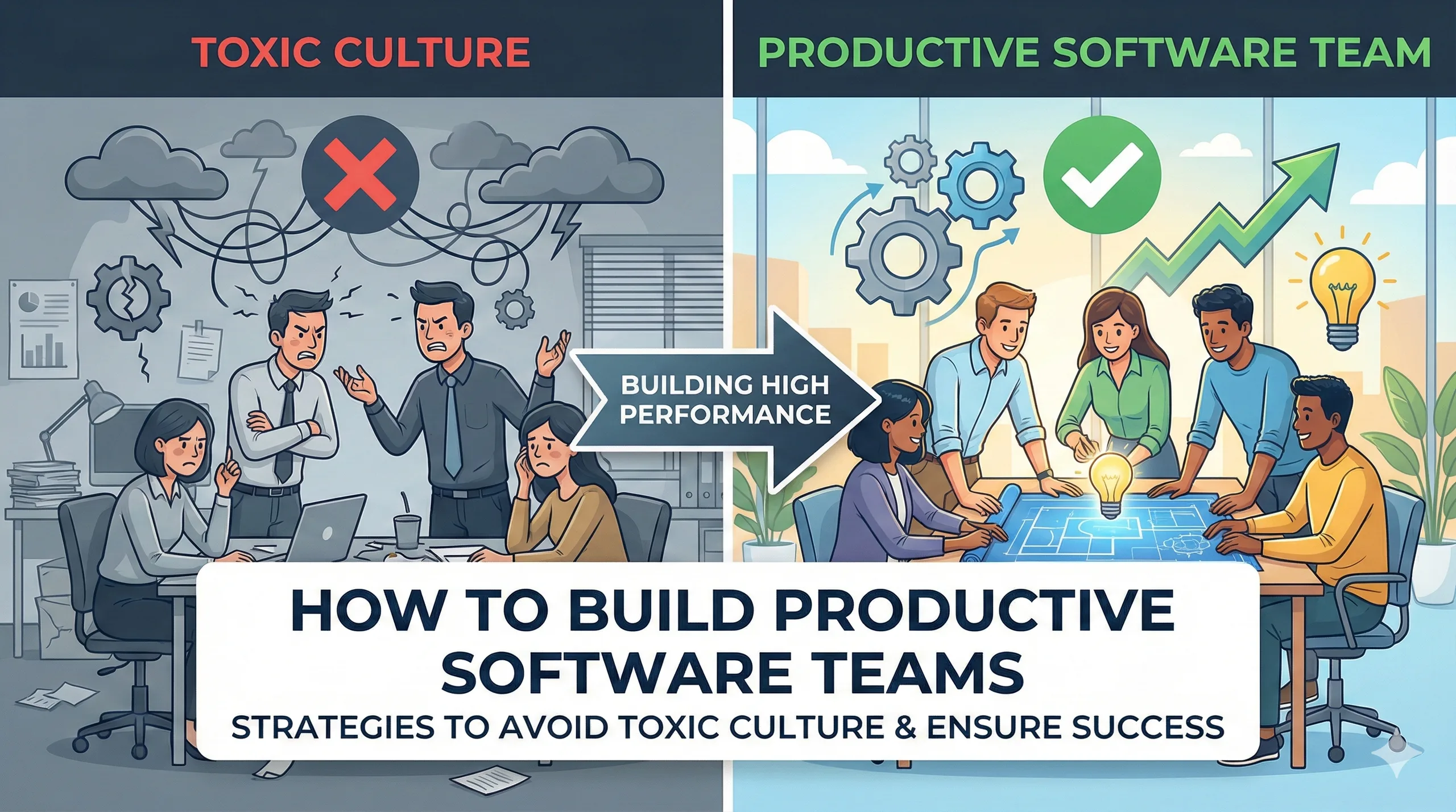
Building a productive software team requires more than technical skills. It demands clear roles, strong leadership and healthy team dynamics. Poor team culture leads to 30 percent higher turnover and missed deadlines.
Toxic environments cause frustration, conflicts and low morale. Productive teams deliver quality software on time through collaboration and accountability. This guide shares practical steps for business owners and managers.
Master these principles to create teams that innovate and execute effectively.
The Four(4) Ps of Effective Software Management
Focus on People, Process, Product and Project for team success. People form the core with skills in recruiting, training and career development. Strong teams emerge from motivated individuals.
Process provides guidelines for tasks like quality assurance and configuration management. Product defines clear objectives and scope to guide development. Project handles planning, scheduling and monitoring.
Balance these elements to avoid common pitfalls like unclear goals or poor communication.
Key Roles in Software Development Teams
Define roles clearly to prevent overlap and confusion. Senior managers set business direction. Project managers plan, motivate and control execution.
Practitioners handle design, coding and testing. Customers define requirements while end users provide feedback. Logistics manage environments and installations.
Team leaders coordinate efforts and resolve issues. Clear roles ensure accountability and smooth workflows.
Qualities of Effective Team Leaders
Great leaders motivate teams to peak performance. They delegate tasks based on strengths and provide authority. Organization skills structure processes from concept to product.
Innovation encourages creative thinking within constraints. Problem solving involves critical analysis and team input. Managerial identity shows confidence, empathy and strong work ethic.
Influence builds teams through understanding signals. Leaders stay calm under stress and reward initiative.
Choosing the Right Team Structure
Select structures based on project size and complexity. Hierarchical structures suit welldefined problems with clear authority. Flat structures promote quick decisions but risk chaos in large teams.
Matrix combines functional and project focus for flexibility. Networked structures work for distributed teams. Consider seven factors: problem difficulty, program size, team duration, modularity, quality needs, deadlines and communication requirements.
Optimal team size ranges from three to eight members for maximum productivity.
| Structure Type | Best For | Key Advantage | Potential Drawback |
|---|---|---|---|
| Hierarchical | Simple tasks | Clear control | Single point failure |
| Democratic | Research projects | High morale | Slow decisions |
| Mixed Control | Large complex projects | Balanced communication | Complex coordination |
Centralized Control Teams
Chief programmer leads with supporting specialists, programmers and librarian. Tasks flow from leader ensuring speed for understood problems. Communication centralizes through the chief.
This structure excels in welldefined projects like payroll systems. Success depends on leader skill avoiding overload. Use for small teams needing rapid execution.
Democratic Team Organizations
All members vote on goals with rotating leadership. Encourages egoless programming and shared review. Ideal for small research teams under six members.
High morale comes from participation but risks chaos in larger groups. Communication flows freely among equals. Best when collective creativity solves unclear problems.
Mixed Control Team Structures
Senior engineers lead junior groups reporting to project managers. Balances hierarchy with peer communication. Suited for large complex programs.
Democratic at senior level decomposes problems. Juniors collaborate within groups. Provides responsibility without full centralization.
Tuckmans Stages of Team Development
Teams progress through Forming, Storming, Norming, Performing and Adjourning. Forming needs high guidance as roles clarify. Storming brings conflicts over purpose requiring resolution.
Norming builds cohesion and processes. Performing achieves maturity with shared responsibility. Adjourning wraps projects with reflection.
Guide teams through each stage for peak performance. Regression happens with changes like new members.
Signs of Toxic Team Culture
Chaotic atmospheres lack accountability standards. High frustration sparks emotional conflicts. Fragmented processes create confusion.
Ambiguous roles send teams wrong directions. Repeated failures blame individuals without learning. These erode productivity and morale.
Preventing Toxic Environments
Encourage teams to review procedures regularly. Provide full information access. Lock major goals unless changes justify shifts.
Delegate decision making maximally. Let teams define accountability and feedback methods. Promote team based problem solving.
Establish clear attendance, punctuality and resource sharing rules. Foster cost consciousness and confidentiality.
Building Team Discipline
Discipline covers attendance, meetings and leave planning. Share resources and avoid waste. Maintain records and analytical approaches.
Escalate issues promptly. Represent organization professionally. Interact positively with customers.
Disciplined teams finish work on time with quality.
Conflict Management Strategies
Conflicts arise from priorities, resources or personalities. Resolve by withdrawing, compromising or confronting causes. Use team or analytical approaches.
Identify problems early. Treat root causes systematically. Emotional approaches suit interpersonal issues.
Proper management turns conflicts into growth opportunities.
Hiring and Staffing Best Practices
Mix junior and senior engineers for knowledge transfer. Minimize turnover on long projects. Match team size to task avoiding overhead.
Staff incrementally: small team for requirements, larger for implementation. Use Rayleigh distribution for efficient utilization. Specialize roles across projects.
Real World Team Examples
Nokia uses software factories with distributed teams, product architecture and concurrent engineering. Tools support requirements to testing.
Open source employs mixed mode with module owners reviewing contributions. Scales functionality without communication overload.
These models prove structured approaches deliver reliable products.
Measuring Team Productivity
Track progress with risk assessment, task breakdowns and schedules. Monitor metrics like delivery dates and quality. Conduct retrospectives for improvements.
Balanced scorecards evaluate people, process and outcomes. Adjust structures based on performance data.
Tools for Team Collaboration
Use Jira for task tracking, Slack for communication and Confluence for documentation. Trello suits small teams, Microsoft Teams for integration.
Version control like Git prevents conflicts. Daily standups maintain alignment.
Scaling Teams for Growth
Add management layers beyond eight members. Maintain span of control. Reorganize incrementally based on design evolution.
Virtual teams need strong communication channels. Train for remote collaboration.
Maintaining Long Term Productivity
Invest in training and career paths. Rotate roles for skill development. Celebrate milestones to sustain morale.
Regular feedback loops refine processes. Adapt structures to project phases.
Partner with TenG Spectrum for Success
Build unstoppable softwares with proven strategies. TenG Spectrum delivers premium web development, SEO and digital solutions remotely. Contact us at teng spectrum to elevate your projects today.
Frequently Asked Questions
Find quick answers to common questions about this topic